Why a Kayak Safety Checklist Matters
The Statistics on Kayaking Accidents
The US Coast Guard’s Annual Recreational Boating Statistics Report consistently shows that the majority of paddlesports fatalities involve kayakers who weren’t wearing personal flotation devices. More concerning: many victims were experienced swimmers who believed they could handle an emergency in the water.
In 2024, kayaks represented the second-highest category of paddlesports deaths. The leading causes?
- Capsizing without the ability to recover
- Cold-water immersion
- Strong currents and unexpected conditions
- Separation from kayaks
- Inadequate communication equipment
Here’s the reality: most of these incidents were preventable with proper preparation. A two-minute pre-launch checklist isn’t just a formality—it’s a life-saving habit.
The Difference Between Prepared and Unprepared Paddlers
Prepared paddlers don’t just survive emergencies—they avoid them. They catch leaking bulkheads before launching. They notice frayed PFD straps. They check weather forecasts and make smart go/no-go decisions.
Unprepared paddlers learn these lessons the hard way, often when help isn’t available.
The good news: you don’t need years of experience to paddle safely. You need a solid checklist and the discipline to use it. This guide gives you both.
Essential Kayak Safety Gear for Every Paddler
This is the foundation of your pre-launch protocol. Every item here serves a specific safety purpose—don’t skip any of them.
Personal Flotation Device (PFD): PFD Requirements for Kayakers
Your PFD is the single most important piece of safety gear you’ll ever own. Federal law requires you to have a Coast Guard-approved wearable PFD aboard your kayak at all times. “Aboard” doesn’t mean “in the dry bag.” It means accessible and wearable.
Choose a PFD designed for kayaking. Recreational life jackets look similar but don’t allow the mobility you need for paddling. Look for a vest-style PFD with:
- Adjustable shoulder straps
- Side adjustments for secure fit
- Large armholes for unrestricted paddle strokes
- Minimal bulk that won’t interfere with your spray skirt
PFD Fit Checklist
Before every launch, verify these points:
- All straps are snug but not constrictive (you should be able to breathe normally)
- The PFD won’t ride up over your chin when you lift your arms
- The buckle or zipper closes fully and clicks into place
- The zipper pull is accessible and functional
- No straps are frayed, torn, or significantly UV-damaged
- The Coast Guard approval label is present and legible
PFD Types Compared
| Feature | Foam PFD | Inflatable PFD |
|---|---|---|
| Buoyancy | Always active | Manual or automatic inflation |
| Comfort | Bulkier, always present | Slimmer profile when deflated |
| Maintenance | Minimal | Requires periodic inspection of mechanism |
| Reliability | Nearly failproof | Dependent on inflation mechanism |
| Best For | Beginners, whitewater | Experienced paddlers, warm-water touring |
Our recommendation: Beginners should start with foam PFDs. They’re always ready and require no maintenance beyond keeping straps functional. See our kayak PFD reviews for 2026’s top-rated options →
Signaling Equipment for Kayak Safety
Sound Signals (Whistle Requirements)
A Coast Guard-approved sound-producing device is required on all kayaks. A whistle is the simplest solution—small, affordable, and highly effective.
Requirements:
- 360° omnidirectional projection
- Minimum 75 decibel output
- Audible from at least half a mile in calm conditions
Keep your whistle in a pocket or attached to your PFD shoulder strap. You’ll need it instantly if you’re in distress, not buried in a dry bag.
Visual Signals (Lights, Flashers)
If you’re paddling in low-light conditions—early morning, evening, or overcast days—you’re required to have a visual signaling device.
Options include:
- Strobe lights: High visibility in all conditions, battery-dependent
- Lanterns: Broader illumination, good for signaling rescuers
- Glow sticks: Emergency backup, limited duration
- LED flag lights: Lower visibility but longer battery life
For most recreational kayakers, a small LED stern light (red/green combination) provides adequate compliance. Serious low-light or nighttime paddlers should invest in a dedicated marine-grade light system. We recommend checking out our curated selection of best kayak safety lights for reliable options.
Protective Clothing and Sun Protection
Sun Protection (2026 Recommendations)
Sun exposure on the water is significantly higher than on land due to reflection off the water’s surface. The American Academy of Dermatology reports that paddlers receive nearly 90% of their daily UV exposure during water activities.
Essential sun protection:
- Broad-spectrum SPF 30+ sunscreen (reapply every 2 hours)
- Water-resistant formula (sweat and spray break down standard sunscreen)
- UV-protective paddling shirt or rash guard with UPF 50+ rating
- Wide-brim hat that won’t blow off (chin strap recommended)
- Polarized sunglasses with floating strap
Cold Water Kayaking Safety: Immersion Protection Gear
Even in warm weather, water temperature can be dangerously cold. Cold-water immersion causes swimming failure within minutes—even for strong swimmers.
Water temperatures below 60°F (15°C) create hypothermia risk. Below 50°F (10°C), you have minutes of functional mobility before losing coordination.
Cold-water paddling requires:
- Wetsuit or drysuit appropriate to water temperature
- Neoprene gloves and socks
- Hood or beanie that covers ears
- Knowledge of cold-water immersion symptoms
If you’re kayaking in water below 60°F, a drysuit with proper underlayers is strongly recommended. See our essential kayak gear guide for 2026 cold-water gear recommendations →
Complete Kayak Equipment Inspection Guide
Your kayak needs a thorough pre-launch inspection. Problems caught on shore are manageable. Problems caught in the water can be life-threatening.
Hull and Hull Integrity Check
Before loading your kayak:
- Inspect the entire hull for cracks, dents, or delamination
- Check around hardware (toggles, handles, pole sockets) for stress fractures
- Look for any sharp edges that could cut your hand during a rescue
- Verify hull plug security if your kayak has a retractable plug system
For composite kayaks, check for spider-web cracking that indicates impact damage. For plastic kayaks, look for deep scratches that have compromised the hull thickness.
Seals, Scuppers, and Drain Plugs
Sit-on-top kayakers should verify that scupper holes are clear and functioning. Water should flow through these self-draining holes freely.
Sit-inside kayakers need to check:
- Hatch covers: Ensure the seal is intact and the cover clicks fully into place
- Bulkhead integrity: Knock lightly on each compartment—it should sound solid, not hollow or soft
- Drain plug: Tighten securely by hand (never over-tighten with tools)
- Skirt compatibility: Verify your spray skirt fits the cockpit rim snugly
Kayak Safety Lights for Low-Light Paddling
If there’s any chance you’ll be on the water near dawn, dusk, or in fog, you need running lights.
Requirements under Navigation Rules:
- Bow light: White light visible from ahead to 112.5° on each side
- Stern light: White light visible from astern to 135° on each side
- All-round light: If paddling, a 360° white light may substitute for separate bow/stern lights
LED kayak lights are lightweight, USB-rechargeable, and highly visible. Mount them securely with straps or adhesive backing, and test them before launch. Our top picks for reliable LED kayak lights include options with long battery life and durable mounting systems.
Storage and Dry Bag Protocol
Secure all gear before entering the water:
- Dry bags should be sealed (roll-top closure 3+ times)
- Stressed items like fishing rods should be lashed to deck lines
- Loose items must be secured to prevent shifting during paddling
- Heavy items go in the center of the cockpit for proper weight distribution
Kayak Communication & Navigation Safety Essentials
The Float Plan — Tell Someone Your Route
Before every paddle—regardless of length or difficulty—tell someone your float plan. This isn’t paranoia; it’s standard safety protocol.
Your float plan should include:
- Launch point and time
- Planned route and destination
- Expected return time
- Emergency contact number
- Number of paddlers and boats
- Vehicle description and parking location
Check in with your designated contact when you return. If you don’t check in at the expected time, they should know to contact local authorities with your float plan information.
Waterproof Communication Devices for Kayakers
VHF Radios vs. Cell Phones in Waterproof Cases
| Feature | VHF Radio | Cell Phone (Waterproof Case) |
|---|---|---|
| Emergency reach | Coast Guard and nearby vessels | Limited by signal/coverage |
| Weather updates | Real-time marine weather broadcasts | App-dependent, data required |
| Location sharing | DSC can broadcast GPS position | GPS apps with sharing capability |
| Battery life | 8+ hours typical | Varies widely |
| Learning curve | Basic functions simple, advanced features need practice | Familiar to most users |
Best practice: Carry both. VHF radio is your direct line to rescue services, especially offshore or in areas with poor cell coverage. A waterproofed cell phone provides additional capabilities and photography. For serious paddlers, we recommend investing in a quality VHF radio as your primary emergency device.
Navigation Tools for 2026 Kayakers
GPS and Chartplotter Apps
Modern kayakers have incredible navigation tools at their fingertips. Apps like Navionics, Gaia GPS, and calTopo offer detailed nautical charts, offline functionality, and GPS tracking.
Key features to use:
- Offline maps: Download charts before launch for areas without cell signal
- Track recording: Log your route so you can retrace your path if needed
- Waypoint marking: Mark your launch point, take-out, and points of interest
- Depth contours: Essential for coastal paddling to avoid shallow areas
Traditional Compass as Backup
Electronic navigation fails. Batteries die. Phones break. A simple magnetic compass is the backup that has saved countless paddlers over the years.
You don’t need to master celestial navigation—just understand how to:
- Read a map and orient it to north
- Use your compass to maintain a heading
- Identify major landmarks along your planned route
Kayak Weather & Environmental Assessment for Safe Paddling
Pre-Launch Weather Check Protocol
Check weather before every paddle, ideally the morning of your trip and again 30 minutes before launch.
What to verify:
- Wind speed and direction: Strong winds (>15 mph) create difficult conditions for smaller watercraft
- Wave height: Even small waves can be challenging; anything over 1-2 feet requires experience
- Precipitation: Rain reduces visibility and can rapidly cool body temperature
- Temperature: Both air and water temperature matter
- Lightning risk: Postpone your paddle if thunderstorms are forecasted
- UV index: Factor sun protection requirements accordingly
Resources:
- National Weather Service marine forecasts
- Windy.com for detailed wind modeling
- Your local paddling club for area-specific knowledge
Wind Speed Guidelines for Kayakers
| Wind Speed | Conditions | Recommendation |
|---|---|---|
| 0-10 mph | Light, manageable | Normal paddling conditions |
| 10-15 mph | Noticeable resistance | Experienced paddlers only; beginners stay home |
| 15-20 mph | Challenging paddling | Avoid for most recreational paddlers |
| 20+ mph | Dangerous conditions | Stay off the water |
Reading Water Conditions for Kayak Safety
Beyond weather, assess the water itself:
- Currents: Check for tidal flows, river currents, or channel crossings
- Traffic: Identify boat lanes and high-traffic areas
- Hazards: Note visible markers, shoals, strainers (submerged trees/branches), and breakwaters
- Water temperature: Use a remote thermometer or check regional databases
If you’re new to reading water conditions, our comprehensive guide to understanding currents and water conditions will help you make safer decisions on the water.
Tides, Currents, and Local Hazards for Kayakers
If you’re paddling in tidal waters, understanding tidal flow is essential. A 2-knot current against a beginner paddler’s 3-mph stroke speed cuts your effective progress to a crawl.
Tools for tidal planning:
- Tide tables or apps (Tides Near Me is excellent)
- Local knowledge from paddling clubs or outfitters
- NOAA tidal current predictions
Kayak Group Safety Protocols for Multi-Paddler Excursions
Buddy System Essentials
Never paddle alone if avoidable. When paddling with others:
- Agree on a formation (side-by-side, single file, or staggered)
- Designate lead and sweep paddlers who bookend the group
- Maintain visual contact at all times—no one disappears from view
- Establish communication signals for regrouping, hazard warnings, and assistance
If someone in your group is less experienced, they should paddle near the middle of the group with a strong paddler nearby.
Group Communication Signals for Kayakers
Standard paddling signals that every group should know:
- “Stop” / “Attention”: One arm raised vertically with paddle
- “Come here” / “Regroup”: Wave paddle in a circular motion overhead
- “I’m OK” / “All clear”: Thumbs up
- “Hazard ahead”: Point toward the hazard with paddle
- “Help needed”: Wave arms overhead in distress pattern
Learn and use these signals before you launch. Verbal communication becomes impossible with wind, waves, and distance.
What to Do If Someone Capsizes
Every paddler should know rescue basics. We’ll cover these in depth below, but the group protocol is:
- Stay calm. Your clear head helps everyone.
- The capsized paddler should hold onto their kayak and float beside it—don’t swim away from your flotation.
- Fellow paddlers approach from downwind/downcurrent to avoid collision.
- Provide verbal guidance before attempting a physical rescue.
- Execute the rescue appropriate to conditions and skill level.
- Reassess and regroup before continuing.
Kayak Emergency Response Preparation & Rescue Techniques
First Aid Kit Basics for Kayakers
Your paddling first aid kit should include:
| Category | Items |
|---|---|
| Wounds | Gauze pads, adhesive bandages, medical tape, antiseptic wipes, tweezers |
| Burns/Blisters | Blister pads, burn gel, second-skin dressings |
| Pain/Inflammation | Ibuprofen, aspirin, instant cold packs |
| Marine Stings | White vinegar (for jellyfish stings), antihistamine |
| Sun/Heat | Sunscreen, electrolyte packets, water purification tablets |
| Emergency | Emergency blanket, CPR barrier mask, SAM splint |
Keep your first aid kit in a waterproof container or dry bag. Inspect it before each season and replace expired items.
Kayak Rescue Techniques (2026 Best Practices)
Self-Rescue Techniques
If you capsize and can’t re-enter from the water:
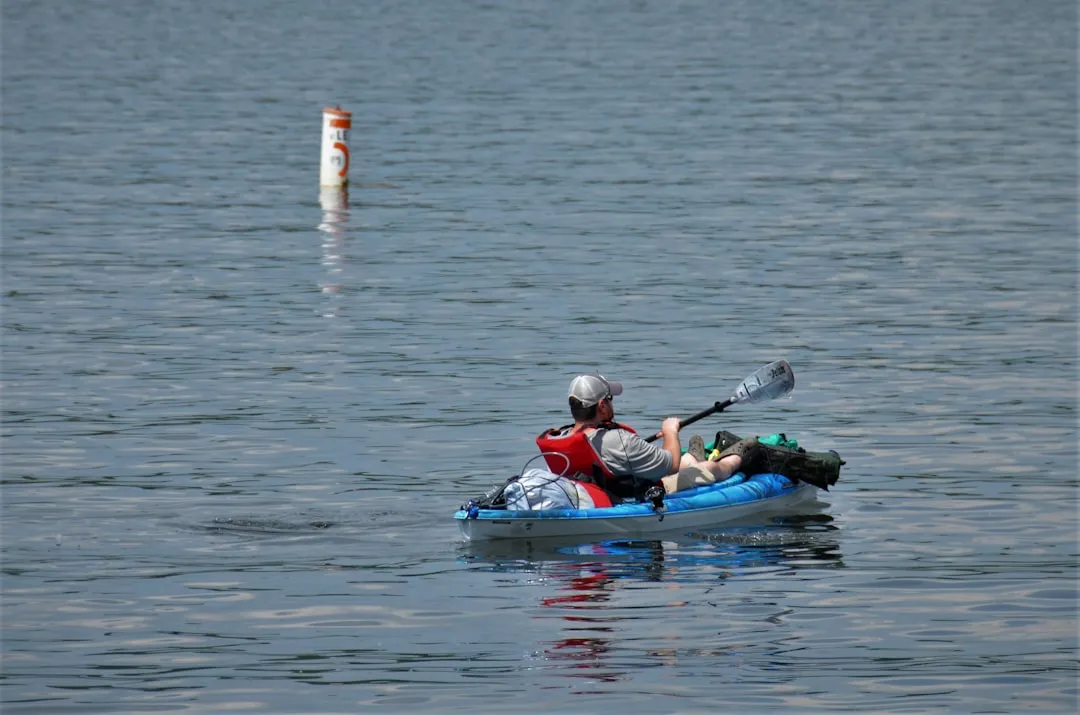
Wet exit: Stay calm, establish which way is up, deflate your spray skirt, and exit the cockpit. Don’t panic—buoyancy will bring you up naturally.
Paddle float rescue: Attach your paddle float to one end of your paddle, secure it under your thigh, and use it as a stabilizing platform to roll back into your kayak. A reliable paddle float is essential safety gear for any paddler venturing beyond calm flatwater.
Scramble rescue: Swim to your kayak’s side, get your hips over the centerline, and roll forward onto the deck. Use momentum and body position rather than arm strength.
Assisted Kayak Rescue Techniques
T-rescue: The rescuer positions their kayak perpendicular to the capsized paddler’s kayak, creating a stable platform. The capsized paddler holds both kayaks steady while working to drain water and re-enter.
Scoop rescue: The rescuer approaches parallel, reaches across to stabilize the swimmer’s kayak, and helps guide the swimmer back into the cockpit.
Rescue command chain: The swimmer should follow the rescuer’s verbal instructions. Trying to simultaneously rescue someone and give directions is overwhelming—agree on who leads before you practice.
See our complete kayak rescue guide for beginners with step-by-step video instructions →
Emergency Contacts and Numbers to Have
Save these in your phone before every paddle:
- Local Coast Guard station: Pre-save for your paddling area
- Local water rescue (fire department): For inland waterways
- Marine patrol/non-emergency line: Non-urgent assistance
- 911: Emergency response
- Paddle buddy contact: Your float plan contact
Post-Paddle Safety Checklist: Gear Maintenance & Debrief
Your safety protocol doesn’t end when you reach shore. What you do after your paddle affects your next outing.
Gear Rinse and Dry Protocol
Rinse all gear with fresh water, especially when paddling in salt or brackish water:
- Rinse PFD thoroughly (salt degrades straps and buckles over time)
- Flush paddle hinges and pushbuttons with fresh water
- Rinse kayak hull and inspect for new damage
- Remove hatch covers to air-dry compartments
- Check and rinse safety gear (lights, VHF radio, PLB)
Equipment Inspection After Launch
After every paddle, note any wear or damage you observed:
- Hull damage or scratches to note
- Strap or closure issues on gear
- Battery levels on electronic devices
- Condition of deck lines or bungees
- Any gear that needs replacement before next launch
Address these issues promptly. A small problem ignored becomes a dangerous problem later. Follow our kayak storage and maintenance guide for seasonal care best practices →
Debrief: What to Note for Next Time
Take 5 minutes after each paddle to note:
- Route specifics: What worked? Where was navigation tricky?
- Conditions encountered: Did forecasts match reality?
- Gear performance: What failed or disappointed you?
- Lessons learned: What would you do differently?
This debrief process compounds over time, making you a better, safer paddler with every outing.
Frequently Asked Questions
Do I really need to wear a PFD at all times?
Yes. Wearing a PFD at all times while on the water isn’t just legally required in most jurisdictions—it’s the single most effective way to prevent drowning. The US Coast Guard reports that over 80% of paddlesports fatalities involve victims who weren’t wearing their PFDs.
Your PFD should be worn, not just aboard. Keep it on from the moment you launch until you’re completely out of the water.
What safety gear is legally required?
Requirements vary by jurisdiction, but federal minimum requirements for kayaks include:
- One wearable PFD (Coast Guard-approved Type I, II, III, or V) per person
- Sound-producing device (whistle or horn)
- Visual distress signals if paddling after sunset, before sunrise, or in reduced visibility
- Lights if operating between sunset and sunrise
Check your state’s specific regulations. Some states have additional requirements for registration, education, or equipment.
How often should I replace my safety equipment?
PFDs: Replace every 5-10 years or immediately after any significant impact. UV exposure, salt, and general wear degrade foam and straps over time.
Throw bags: Inspect rope annually; replace if showing signs of UV damage, fraying, or compromised stitching.
Dry bags: Check seams annually; replace if seals are sticky, cracked, or not sealing properly.
Paddles: Look for shaft ovaling, blade delamination, or loose ferrule connections.
Lights and electronics: Replace batteries per manufacturer recommendations; replace units showing any signs of malfunction.
Can I use my phone as my only communication device?
A phone in a waterproof case is better than nothing, but it shouldn’t be your only communication device. Cell coverage is unreliable on many waterways, battery life is limited, and phones can’t broadcast your position to rescue services.
We recommend a VHF radio or personal locator beacon (PLB) as your primary emergency communication device, with your phone as a backup for text-based communication and non-emergency contact.
Conclusion
Two minutes of pre-launch preparation can prevent hours of emergency response.
This checklist isn’t about fear or overcaution. It’s about building the habits that let you paddle confidently, knowing you’ve done everything reasonable to stay safe. Every item on this list exists because someone learned its importance the hard way.
Make this checklist part of every paddling routine. Download it, print it, save it to your phone. Review it before your first paddle of the season. Share it with paddlers who might need the reminder.
Quick checklist summary:
- PFD worn and fitted properly
- Signaling equipment accessible
- Kayak inspection complete
- Communication devices charged and ready
- Weather confirmed safe
- Float plan filed with someone
- Group signals agreed upon
- Emergency contacts saved
- Post-paddle debrief notes reviewed
You’re now equipped with a complete pre-launch safety protocol. Use it.
Ready to keep building your skills? Explore our beginner kayaking guides for foundational paddling technique, or check our how to read water guide for deeper environmental assessment strategies.
Stay safe out there.
Everything On The Water.