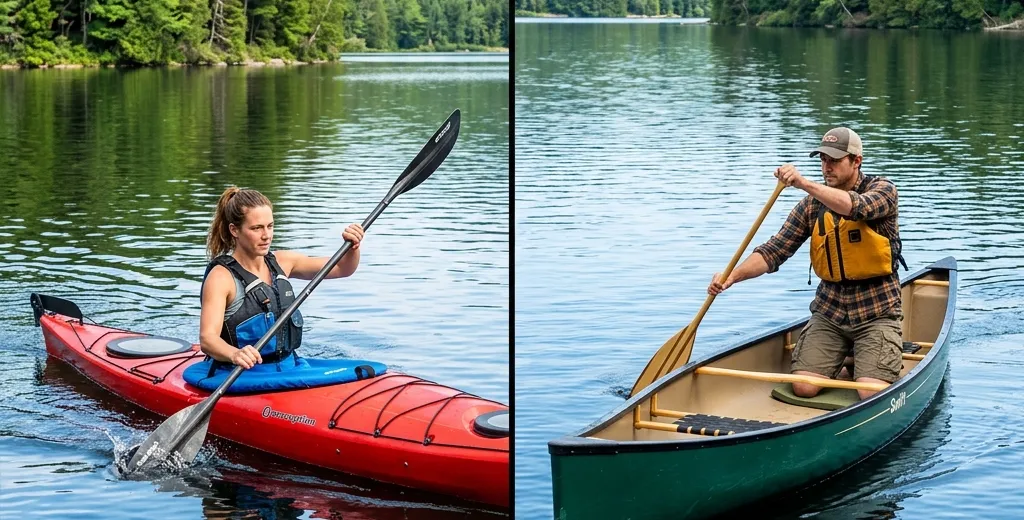
You’re standing at the water’s edge, trying to decide which boat to rent—kayak or canoe. Both look fun. Both involve paddling. And yet the choice you make will completely change your experience on the water.
This isn’t a matter of one being “better.” Kayaking and canoeing are genuinely different activities built around different design philosophies, skill sets, and ideal scenarios. The right choice depends on where you’re paddling, who you’re paddling with, and what you want to do when you get there.
Let’s cut through the confusion.
The Fundamental Difference: It Starts With the Paddle
The quickest way to tell a kayak from a canoe isn’t the boat itself—it’s the paddle.
Kayak paddle: Double-bladed. You alternate dipping each end into the water, pulling the boat forward in a rhythmic, cross-body motion. The blades are typically feathered (angled against each other) to reduce wind resistance.
Canoe paddle: Single-bladed with a T-grip handle. You stroke on one side and must switch sides periodically—or use a J-stroke—to keep a straight course. It requires more technique but offers more finesse.
This single distinction ripples through everything else: boat design, seating position, stability, cargo capacity, and where each excels.
How the Boats Are Built Differently
Kayaks: Closed (or Semi-Closed) Deck Design
Most kayaks have a closed deck—your legs are inside the hull, and you sit low with legs extended forward. Sit-on-top kayaks are an exception, but even those keep your center of gravity lower than a canoe.
The cockpit of a sit-inside kayak can be sealed with a spray skirt, a neoprene or nylon cover that prevents water from washing in. This makes kayaks suitable for moving water, ocean swells, and cold-weather paddling where staying dry matters.
Kayak hull shapes vary widely:
- Recreational: Wider, more stable, easier to turn—good for flat water and beginners
- Touring/Sea: Longer, narrower, faster with better tracking—designed for distance
- Whitewater: Short, highly maneuverable with a rocker profile to handle rapids
Canoes: Open Deck Design
Canoes have an open hull—no deck, no enclosure. You sit on a bench or kneel on the hull floor, paddling from a higher position. This open design means you can load up significantly more gear, making canoes the go-to choice for multi-day wilderness trips where you’re portaging between lakes.
Common canoe styles:
- Recreational/flatwater: Wider beam, stable, easy to load
- Whitewater canoe: Lower sides, more rocker, sometimes paddled solo
- Expedition/touring: Longer and narrower for efficient straight-line travel
The canoe’s open design is both its greatest strength and its biggest weakness. You can haul camping gear for a week-long trip. But you’re also fully exposed to wind, waves, and rain.
Stability: Which Is Easier to Not Flip?
This is the question everyone asks, and the answer is more nuanced than most guides admit.
Primary vs. Secondary Stability
Primary stability is how stable a boat feels when you’re sitting flat and still. Secondary stability is how well it resists capsizing when you lean or hit rough water.
Most canoes have high primary stability—they feel rock-solid when you step in and sit down. A wide, flat-bottomed canoe is hard to tip unintentionally. But once you lean past its secondary stability threshold, it goes over fast.
Recreational kayaks also have solid primary stability, but narrower touring kayaks can feel tippy to beginners. The upside? A properly designed kayak often has better secondary stability—you can lean into turns and eddy out in moving water without flipping.
Practical verdict for beginners: A wide recreational canoe or recreational kayak will feel stable. A sea kayak or whitewater canoe requires more skill to stay upright.
Difficulty and Learning Curve
Which Is Easier to Learn?
For absolute beginners on flat water, kayaking is generally considered easier to learn in the first session. The double-bladed paddle is more intuitive—you just alternate sides and the boat moves forward without much thought. Steering requires some practice but comes quickly.
Canoeing has a steeper initial learning curve because:
- You must actively switch sides or use corrective strokes to go straight
- The J-stroke and draw stroke take time to develop
- Reading the canoe’s response to wind requires experience
- If you’re in the stern of a tandem canoe, you’re responsible for steering
That said, becoming a skilled canoeist takes longer, but intermediate canoeing is deeply satisfying. There’s an artistry to moving a canoe efficiently that kayaking doesn’t replicate.
Solo vs. Tandem
Canoes are naturally suited to tandem paddling. Two paddlers—one in the bow, one in the stern—can cover serious mileage efficiently. Solo canoeing is absolutely possible but requires more technique to compensate for unbalanced power.
Kayaks are most commonly paddled solo, though tandem kayaks exist. Tandem kayaking doesn’t require the same coordinated strokes as canoeing, which makes it more forgiving for inexperienced pairs.
Speed and Efficiency
On flat water over distance, a well-designed touring kayak will typically be faster than a comparable canoe. The lower, more hydrodynamic profile cuts through water with less resistance. A touring kayak cruises at 3–5 mph; a canoe typically sits at 2.5–4 mph under the same effort.
However, a tandem canoe paddled by two competent paddlers can match or exceed a solo kayaker over distance. And in expedition contexts where you’re carrying 80+ lbs of gear, the canoe’s efficiency with a load becomes more relevant.
For day trips: Touring kayaks are faster.
For loaded multi-day trips: The gap narrows considerably.
Cargo Capacity: The Canoe Wins, Decisively
This is the area where the canoe has a clear advantage and always will.
| Boat Type | Typical Cargo Capacity |
|---|---|
| Recreational kayak | 250–300 lbs (including paddler) |
| Sea/touring kayak | 300–400 lbs |
| Recreational canoe | 800–1,000+ lbs |
| Expedition canoe | 1,200+ lbs |
A 17-foot canoe can carry a week of food, camping gear, a dry bag full of clothes, and two people—all without feeling overloaded. You can literally bring a cooler.
Kayaks rely on hatches and deck rigging for storage. A 16-foot sea kayak has bow and stern hatches that can hold a surprising amount, but you’re doing Tetris-level packing, not casual gear stowing.
If you’re planning a multi-day camping trip on a river system or a chain of lakes, the canoe’s cargo advantage is decisive.
Where Each Boat Performs Best
Kayaking Is Better For:
- Ocean and coastal paddling – spray skirts and low profiles handle waves better
- Whitewater – kayaks are purpose-built for rapids and technical river features
- Day trips on lakes and rivers – faster, easier to handle solo
- Fitness paddling – the high-cadence paddling style is more cardiovascular
- Cold water environments – closed deck and spray skirt keep you drier and warmer
- Fishing – sit-on-top kayaks have become the dominant fishing platform due to stability, rod holders, and pedal-drive options
Canoeing Is Better For:
- Multi-day wilderness trips – unmatched gear capacity for portaging routes
- Family paddling with young kids – open hull means kids aren’t confined, and there’s room to shift positions
- Dog paddling – canoes accommodate dogs far more comfortably
- Photography and wildlife watching – easier to move around in an open boat
- Rivers with frequent portaging – easier to flip upside down and carry overhead
- Fishing with multiple rods and a big cooler – the open hull makes it practical
Cost Comparison
Entry-level kayaks and canoes overlap significantly in price, but the ranges diverge:
| Type | Entry Level | Mid-Range | High-End |
|---|---|---|---|
| Recreational kayak | $300–$600 | $700–$1,200 | $2,000+ |
| Sea/touring kayak | $1,000–$1,800 | $2,000–$3,500 | $5,000+ |
| Inflatable kayak | $100–$400 | $400–$900 | $1,500+ |
| Recreational canoe | $400–$800 | $900–$1,500 | $2,500+ |
| Kevlar expedition canoe | $2,500–$4,000 | $4,000–$7,000 | — |
Accessories also factor in:
- Kayak paddles: $50–$400+
- Canoe paddles: $40–$300+
- PFDs: $30–$150 either way
- Spray skirts (kayak only): $50–$200
- Portage yoke (canoe only): $80–$200
For beginners, the costs are comparable. As you move into serious touring or expedition paddling, high-performance kayaks and expedition canoes both escalate sharply.
Safety Considerations
Kayaking Safety
The closed deck of a kayak is a safety advantage in rough water—you won’t fill with water in waves. However, a capsized sit-inside kayak requires a wet exit and self-rescue technique that beginners should learn before paddling open water. Practicing wet exits in a pool or shallow water before your first lake paddle is essential.
Sit-on-top kayaks are arguably the safest option for beginners—if you capsize, you simply right the boat and climb back on.
Canoeing Safety
A capsized canoe is easier to deal with in calm water because you can grab the gunwale and right it. However, swamped canoes in moving water are serious—an open hull fills quickly, and a waterlogged canoe in current can pin against obstacles.
Both sports require a properly fitted PFD, appropriate clothing for water temperature (not air temperature), and knowledge of the waterways you’re paddling. The rule is the same: dress for immersion, not the weather.
For a complete rundown on pre-launch essentials, see our kayak safety checklist.
The Honest Answer: Which Should You Choose?
Stop looking for the “objectively better” answer—it doesn’t exist. Here’s a practical decision matrix:
Choose a kayak if:
- You want to paddle solo with speed and efficiency
- You’re interested in whitewater or ocean paddling
- You want a fitness-focused activity
- You’re going on day trips, not multi-day expeditions
- You want to go fishing on a technical water body
- Cold water is involved and staying dry matters
Choose a canoe if:
- You’re going on a multi-day camping trip and need to carry gear
- You’re paddling with a family including young children or a dog
- You prefer an open, social paddling experience
- You’re exploring a river system with portages
- You want to move around in the boat freely
If you truly can’t decide:
Try both. Most outfitters rent both styles. A half-day rental on each—even back to back—will give you a visceral sense of which feels right. No article can substitute for that.
Can You Do Both?
Absolutely—and many paddlers do. Kayaks and canoes complement each other. A paddler might use a sea kayak for coastal day trips and a canoe for annual canoe-camping trips. The skills overlap more than you’d expect: reading water, understanding currents, weight distribution, and weather awareness are universal.
If you’re starting from zero and must pick one to learn first, consider your most likely use cases. But don’t treat it as a lifetime commitment. Most people who fall in love with one eventually try the other.
FAQ: Kayaking vs Canoeing
Is kayaking harder than canoeing?
For complete beginners, kayaking tends to be easier to pick up in the first session because the double-bladed paddle is more intuitive. Canoeing has a steeper learning curve but a rich skill ceiling.
Can one person paddle a canoe?
Yes, but it requires more technique. Solo canoeists often use a bent-shaft paddle and a modified J-stroke, and some solo canoes are specifically designed with a centered seat and symmetrical hull for one paddler.
Which is safer: kayak or canoe?
Neither is inherently safer. Safety depends on water conditions, proper gear (PFD, appropriate clothing), skill level, and trip planning. Both sports have their specific hazards.
Is a canoe or kayak better for beginners?
A wide recreational kayak on flat water is often recommended as the most beginner-friendly starting point. A wide recreational canoe is equally approachable. The real answer is: either works, as long as you’re on calm water with a properly fitted life jacket.
Which is better for camping trips?
Canoes. The cargo capacity advantage is significant for multi-day wilderness trips, and the open hull makes it easier to load and access gear.
Whether you’re leaning toward the efficiency of a kayak or the expedition capability of a canoe, both are gateways to serious time on the water. The best choice is the one that matches how you actually paddle.
Check out our complete guide to kayak types to dig deeper into the kayak side of things, or browse our beginner’s gear guide before your first trip.